RESULT/SOLUTION
Tempe in 2050 does not have to choose between being a tech city and being a city for everyone. The signals told us that. The residents told us that. Our two final scenarios gave the city a framework to pursue both, with careers that are sustainable, accessible, and built around the people already living there.
Project Partners

Andrew Whitcomb
Project Lead & Professor
Arizona State University

City of Tempe
Sustainability Director
City of Tempe

Alison Almand
Program Manager
Community Engagement

wydale k. Holmes
Director
Director, Strategic Management and Innovation Office
09 — WHAT IT TAUGHT ME
Design happens everywhere.
Not just at a desk.
I used to think design happened at a desk. This project taught me it happens at farmers markets, in libraries, in city council chambers — anywhere people are making decisions about their lives.
The best research tool I used on this project wasn't a survey or a prototype. It was showing up and listening without an agenda.
My e-waste idea came from a conversation I wasn't supposed to be having, with a student who was scared about her future. That's the kind of signal you only catch if you're actually present.
Tempe Futures made me a better researcher. But more than that it showed me what civic design can do when it's done with genuine respect for the people it's for.
I came in knowing how to make things look good. I left knowing how to make things matter.
The e-waste career pathway I proposed made it into the final deliverable to the City of Tempe. That's the most concrete impact I've had on a real community through design.
📰 Featured in ASU Newsletter — March 2026
Community Engagement
Speculative Design
Survey Design
Workshop Facilitation
Stakeholder Management
Public Speaking
Futures Thinking
Signal Analysis

05-FINAL RESULT - MAYOR ENGAGEMENT
My Impact
I was one of 9 members on the Pop-Up Engagement Team, the only one representing the Career focus area. The flashcards I designed were used across both pop-up locations to spark conversations with 300+ community members. The career signals I gathered fed directly into the two final scenarios presented to Mayor Corey D. Woods and Tempe City Council. The e-waste career pathway I proposed made it into the Green Innovators scenario as a concrete, actionable recommendation for Tempe's economic future. From a Sunday morning table on Mill Avenue to a City Council chamber, that idea traveled the full distance.
Project Highlights
Visual journey through community engagement events, workshops, and collaborative design sessions




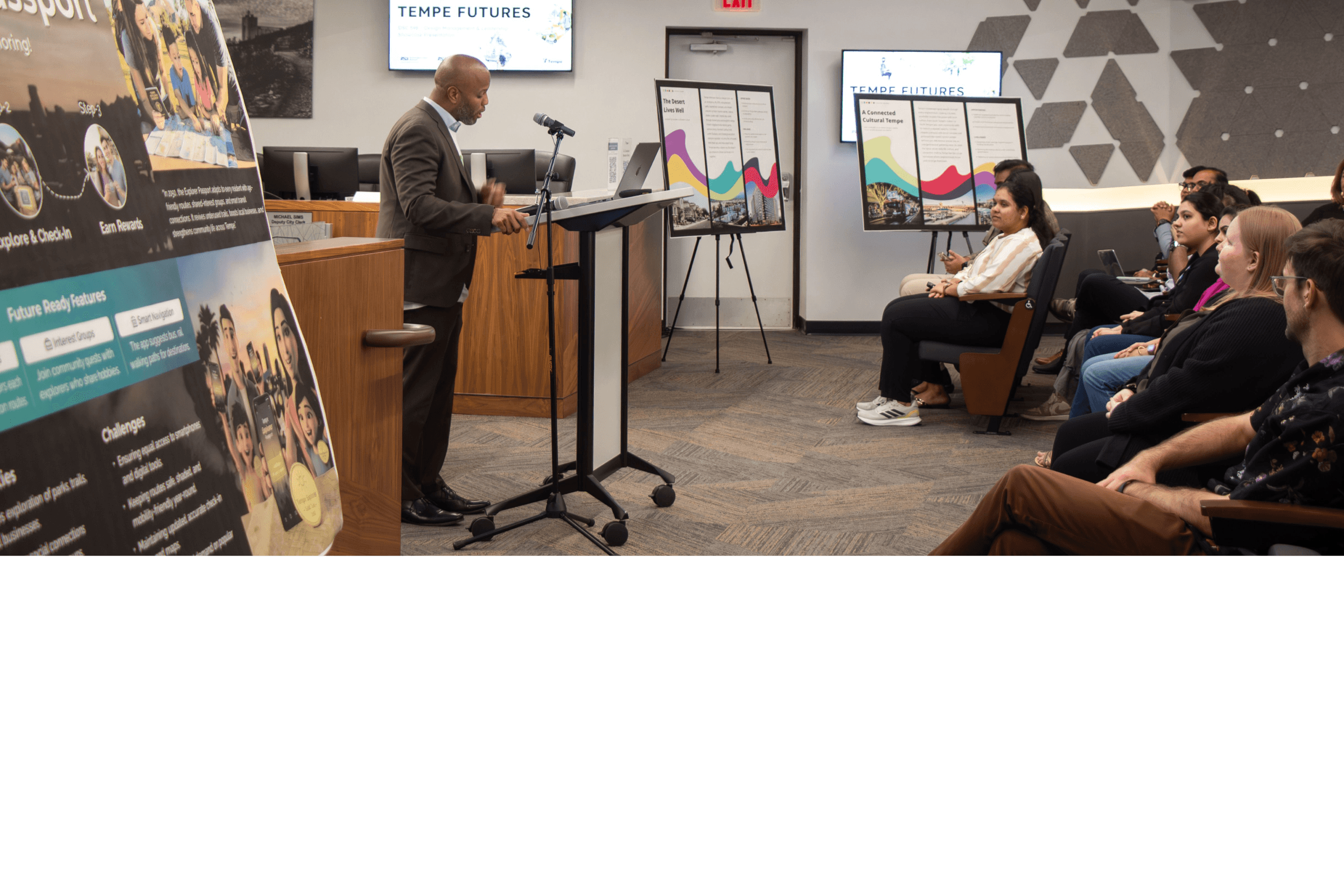
Mayor COREY D. WOODS
Mayor for City of Tempe
Audience
at the city council
Me :)
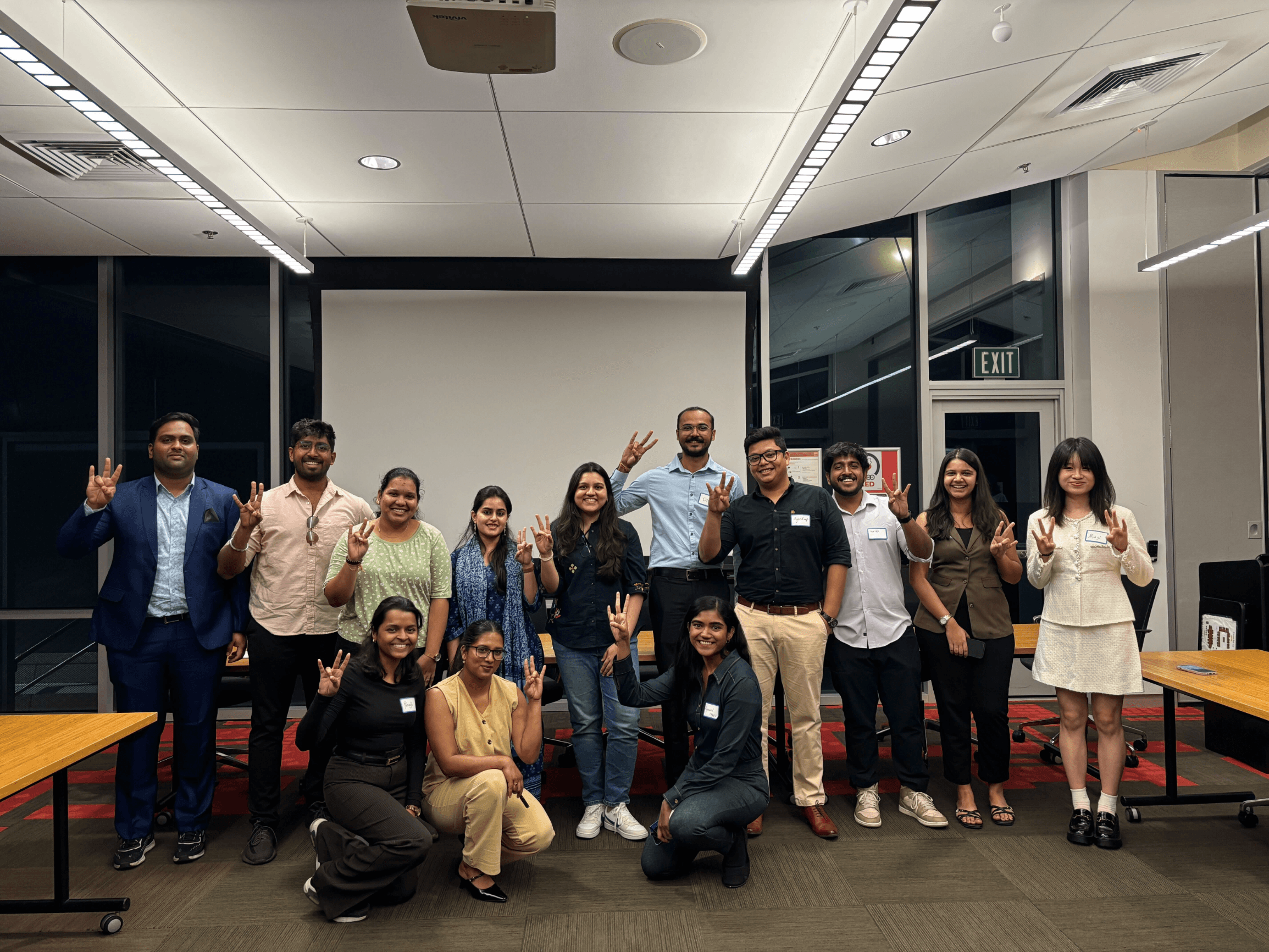
Group photo with the class at the city hall
Interviewing residents on South Mill,Tempe
pop up event at the park
Open House at Tempe Public Library
300+ community members engaged. When asked where career opportunities should grow in Tempe, the responses pointed to the same thing: accessibility. People wanted a career hub near the public library, central enough for elderly residents, youth, and everyone in between to reach easily. Others flagged the Envision Center for its existing career support infrastructure, and several pointed to the Curry Road and Rio Salado Parkway corridor, noting the empty land, the street car access, and the potential to build something new there. The pattern was clear. Tempe residents do not just want more jobs. They want jobs they can actually get to.
Participants leaned toward sustainability careers over healthcare, and service jobs over manufacturing because they wanted to experience the magic of Tempe, not work in a factory. Flexible and hybrid work came up consistently across age groups. On the jobs question, votes split equally between finding a good paying job and starting your own business, until someone suggested both should go hand in hand. That felt like the most honest answer of the night.
BY THE NUMBERS
350+
Students engaged
in workshops
300+
Community members
at pop-up events
127
Signals collected
and synthesized
180+
Open house
attendees
89%
Wanted a hybrid
scenario approach
100%
City Council
buy-in achieved


Scenario Development
After the pop-ups, I came to the City Panel with one job , pressure-test our Career signals against people who actually run the city. We asked whether the industries residents wanted were realistic, whether Tempe had the infrastructure to support them, and whether anyone was thinking about the workforce gap the semiconductor boom was quietly creating. The panel made our signals sharper. Some ideas held up. Others needed rethinking.
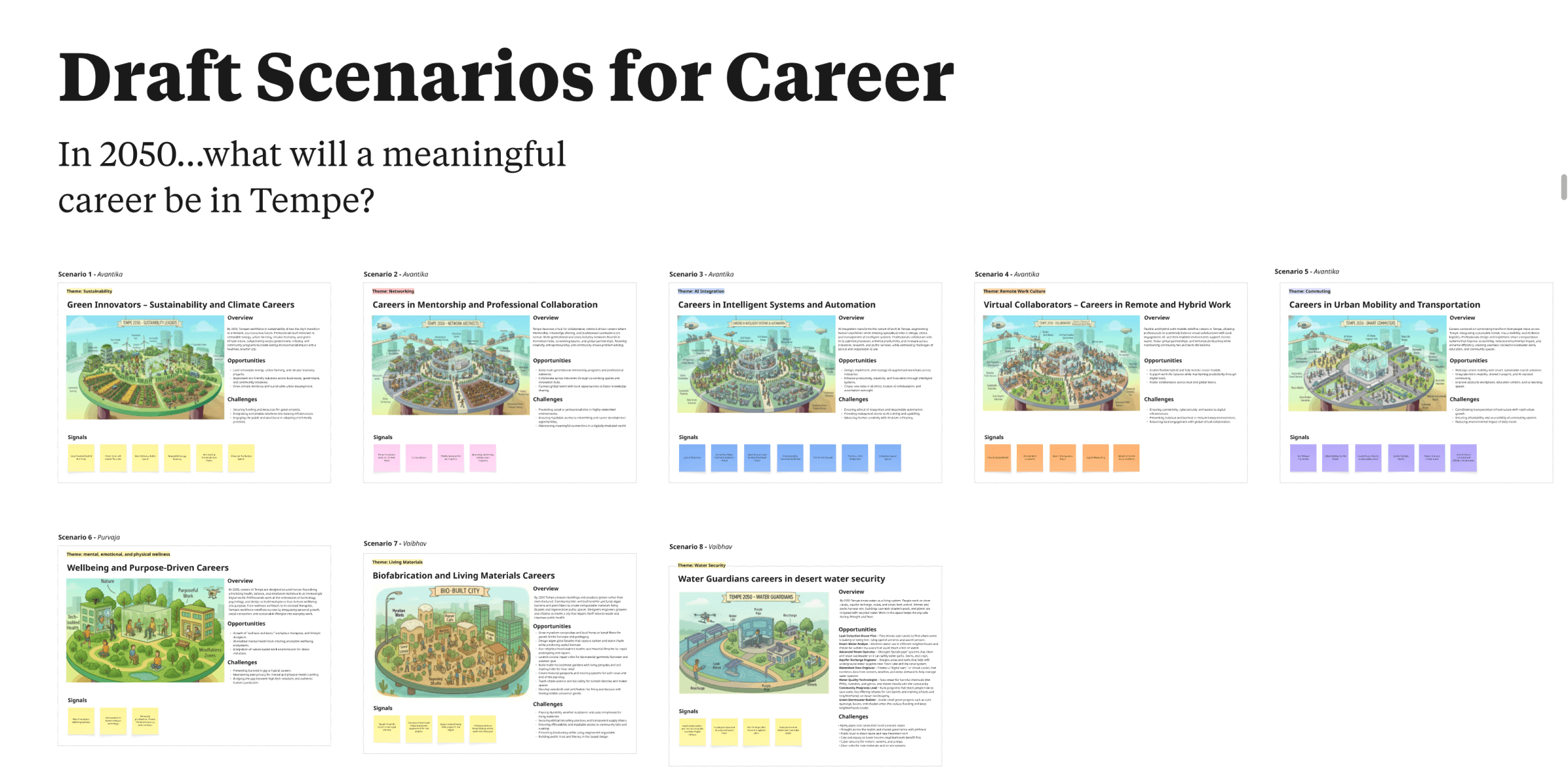
We developed 8 draft scenarios exploring what meaningful careers could look like in Tempe by 2050. Each one was built from real signals, things people told us at pop-ups, in surveys, and through the City Panel. Every scenario had a theme, a vision, opportunities, challenges, and the signals that led us there. These were not guesses. They were grounded responses to what Tempe residents actually told us they needed.

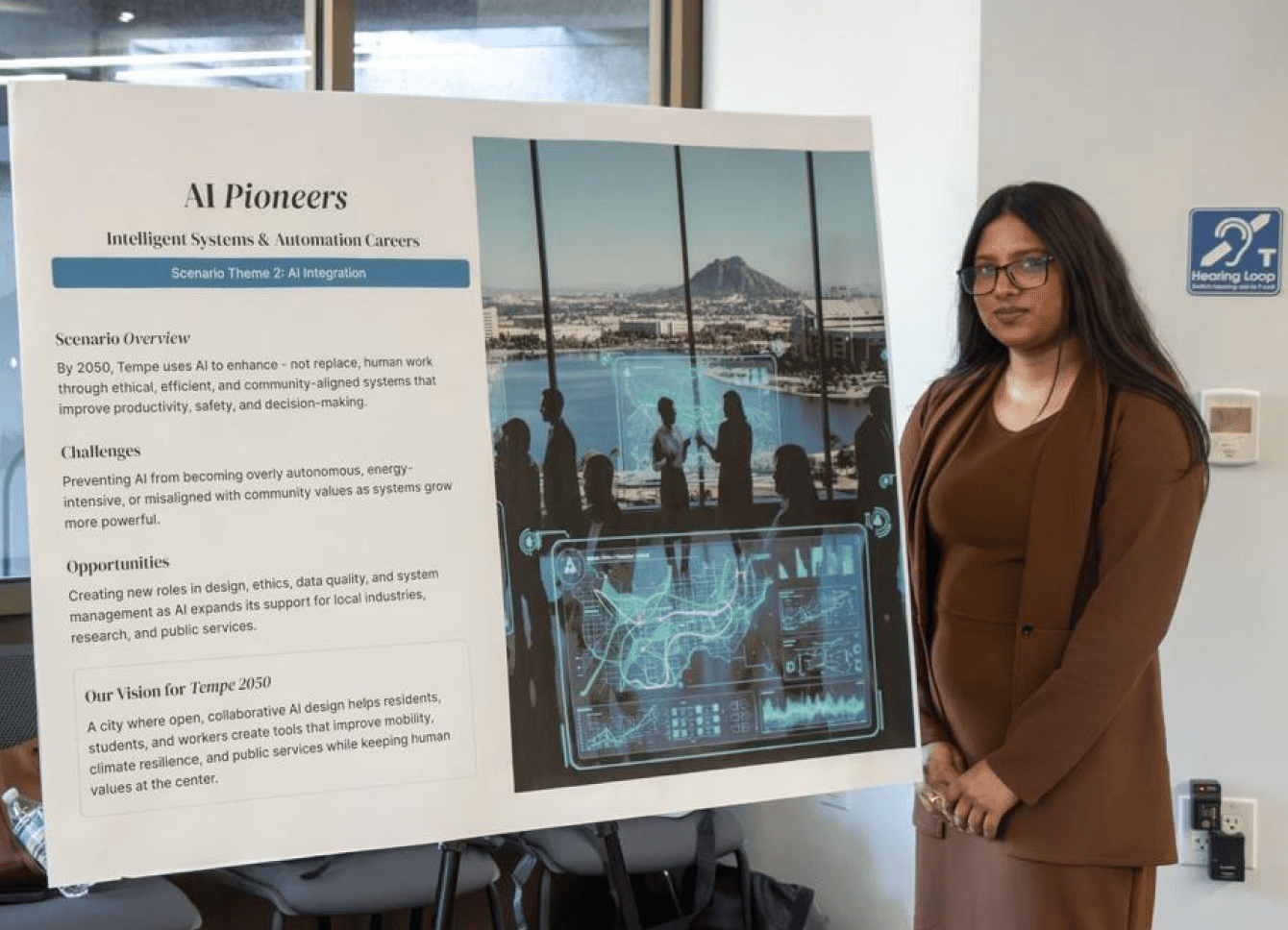
we narrowed down to two. The ones that best captured what Tempe residents actually wanted and what the city could realistically build toward by 2050.

By 2050, Tempe is a living lab for responsible AI built on collaboration between the city, ASU, and local industry. Professionals design and govern systems that manage heat, traffic, and water in real time. Work here means partnering with AI to make everyday life safer, more efficient, and more inclusive, with human values kept at the center

By 2050, Tempe's sustainability workforce has turned a desert college city into a testing ground for climate resilience. Professionals design shaded mobility corridors, run urban farms using reclaimed water, and help local businesses adopt circular economy practices. Every career here is built around living with heat and water scarcity rather than fighting it.
Responses and Outcomes
Jobs disappearing: People flagged cashiers, manual labor, data entry, anything repetitive. Basically everything automation and AI is already eating. Two answers stood out "no job can disappear" and "sadly most art careers." Opposite fears, same table.

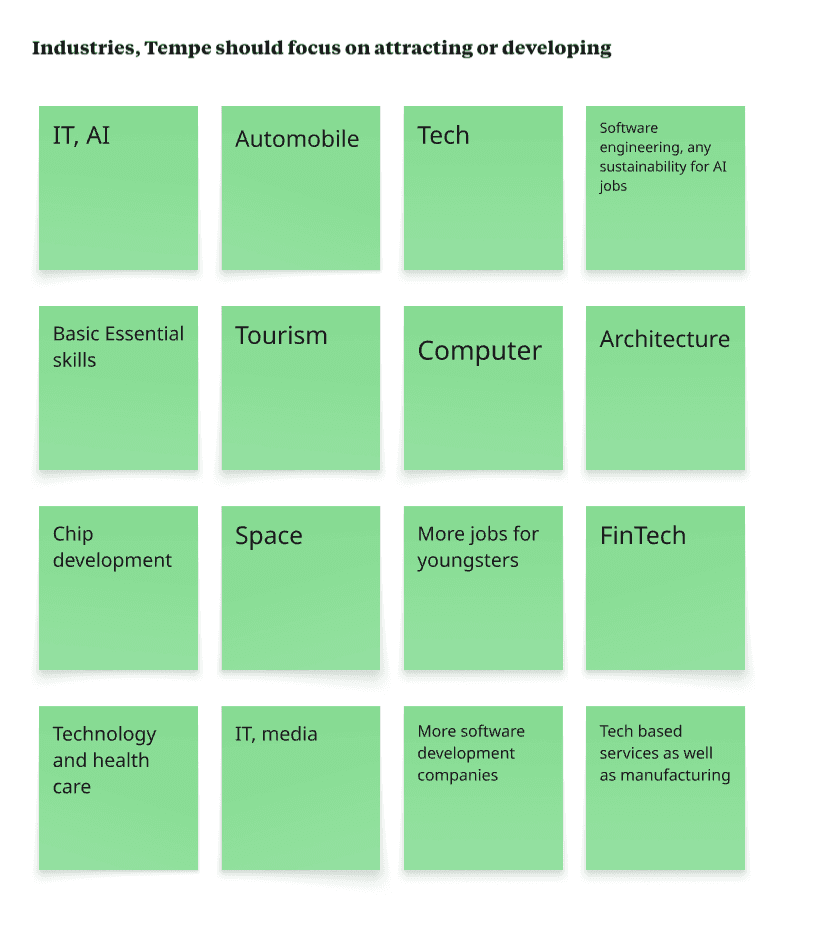
Industries to grow: IT, AI, chip development, FinTech, space, healthcare tech. Someone just wrote "more jobs for youngsters." No frills, just that.
AI comfort level: Nearly half weren't ready to work alongside AI , and that became our biggest insight going into synthesis.

City Panel

The City Panel brought together panelists from across Tempe police, transportation, healthcare, academia, career development, and city leadership. Real decision-makers in the room, not just observers.
What we took forward: Tempe is heading toward a tech-heavy future chips, AI, advanced manufacturing but the people living there aren't sure there's a seat for them at that table. That tension is what our Career team brought to the City Panel, and it's what shaped the scenarios we built.

ENGAGEMENT ACTIVITIES


ASU CAMPUS POP-UP
Our first pop-up was on ASU's Tempe campus. The audience was mostly students.people who were actively thinking about their futures and had a lot of opinions about what Tempe had to offer them professionally.
What I heard: anxiety about relevance. Students weren't just worried about finding jobs after graduation — they were worried about finding jobs that would still exist by the time they were 30. Automation, AI, shifting industries. The signal was real and it was consistent across almost every conversation I had that day.
SUNDAY ON MILLS
The second pop-up was at Sunday on Mills a completely different crowd. Families, older residents, people who had already built lives in Tempe. This is where the signal shifted.
Long-term residents felt like Tempe's economic conversation was happening without them. The city was attracting tech companies and semiconductor plants but nobody was asking whether the people already living there would have a path into those industries. That tension between the city Tempe was becoming and the people already living there became one of the most important signals I brought back to the Career team.

We gathered signals from four different sources : Youth, Residents, Local Experts, and Public Content. Each source gave us a different lens on Tempe's present and future. My contribution focused on the Career focus area, which meant asking people what meaningful work would look like in a city that's changing fast.
THE INSIGHT THAT CHANGED EVERYTHING
"
My e-waste idea came from a conversation with a student who was scared about her future.
Tempe sits in the middle of Arizona's semiconductor corridor. TSMC just built a plant in Phoenix. The region is becoming a hub for advanced manufacturing an industry that produces enormous amounts of electronic waste that needs skilled people to manage.
I brought that signal back to the team. I made the case that e-waste management could be a real, tangible career pathway tied directly to Tempe's economic future and its sustainability goals.
It made it into the final Green Innovators scenario : the one we presented to the Mayor.
SIGNAL TYPE
Personal + Future
→ Economic opportunity
→ Green career pathway

GATHERING SIGNALS
RESEARCH FRAMEWORK · THE THREE HORIZONS MODEL
The Guiding
Framework
How futures thinking structures move from today's reality to 2050's possibilities.
The course used the Three Horizons model to explore the relationship between current ways of living and preferred ways of living in 2050 and beyond. This gave us a structured way to think about change , not as a single leap, but as overlapping transitions.

The goal was twofold: gather signals from each of the three horizons that provide insight into people's lives today and tomorrow, then use those signals as inputs for creating scenarios of possible futures for Tempe.
FOCUS AREAS · FOUR STUDENT GROUPS
Each group explored
one question about
Tempe's future.
The class split into four groups, each focusing on a specific question relevant to future generations living in Tempe.
Group C (3)
LEISURE
What will leisure look like in Tempe?
Group D (4)
HOME-TOWN
What will make Tempe a "home-town"?
Group B (4)
CAREER
What will a meaningful career be in Tempe?
MY GROUP
Group A (3)
HEALTH
How will people stay healthy in Tempe?
04-DESIGN & RESEARCH PROCESS
02 — PROJECT TIMELINE
-Tempe had big plans for the future. Data. Consultants. Long-range reports. What it didn't have was a real, honest picture of what residents students, older adults, families, workers who actually needed and feared and hoped for.
-Traditional civic engagement wasn't reaching the right people. Surveys went to email lists nobody opened. Meetings were held in buildings that felt intimidating. The community had opinions. It just had no meaningful way to share them. Our job was to close that gap through design.
How might we engage diverse community voices to co-create future scenarios for Tempe that embrace extreme heat as a design constraint rather than a problem to solve?
03- THE PROBLEM
AUG 16
Project Kick-off
Workshop overview and initial project process briefing with stakeholders

SEPT - OCT
Course Process
Intensive engagement with 350 students through workshops and design thinking sessions

OCT - NOV
Synthesis
Themes from research inform scenarios: "AI Pioneers" and "Green Innovators"
NOV 16
Open House
300+ community members engage with interactive exhibits at Tempe Public Library

DEC 7
Mayor Engagement
Deliver insights to city leadership with strategic recommendations
Five months.
August to December 2025.
Tempe
Futures
2050
CASE STUDY · ASU × CITY OF TEMPE · AUG — DEC 2025
Designing for a city that doesn’t exist yet
and making sure real people got to shape it.
Pop-Up Engagement Coordinator
+ Career Focus Area Strategist
City of Tempe
ASU Project Cities
300+ Community Members
350+ Students Engaged
Presented to Mayor &
Tempe City Council
MY ROLES
PARTNER
REACH
CULMINATION
I got involved in Tempe Futures 2050 because I wanted to do something that mattered outside of a screen. This was ASU's partnership with the City of Tempe to imagine what the city could look like in 25 years and more importantly, to make sure the people who actually live there got a real say in that future. I held two roles. I was physically out in the community. At ASU campus, at Sunday on Mills : setting up tables, talking to strangers, asking people what they wanted their city to feel like in 2050. I was also on the Career Focus Area team, working on what kinds of industries Tempe should be building toward. Nobody handed me a script. I had to figure out how to make civic design inviting to someone who just came out to grab coffee on a Sunday morning.
You can watch the video demo below to get a quick overview of the project before exploring the case study.