Clarkdale
Water
Conservation
CASE STUDY · TOWN OF CLARKDALE · ASU PROJECT CITIES · FALL 2024 · TWC 501
Environmental Signage Design
Designing interactive, STEAM-focused signage to teach
families and kids how water conservation actually works.
TWC 501
Technical Communication
Landscape Basins
Puzzle Piece Sign
Town of Clarkdale
ASU Project Cities
Team Science
6 Graduate Students
COURSE
MY CONTRIBUTION
PARTNER
TEAM
01 — INTRODUCTION
Clarkdale is a small town in Arizona's Verde Valley with a big identity problem. It sits next to one of the most ecologically significant rivers in the state and most people driving through have no idea what they're looking at.
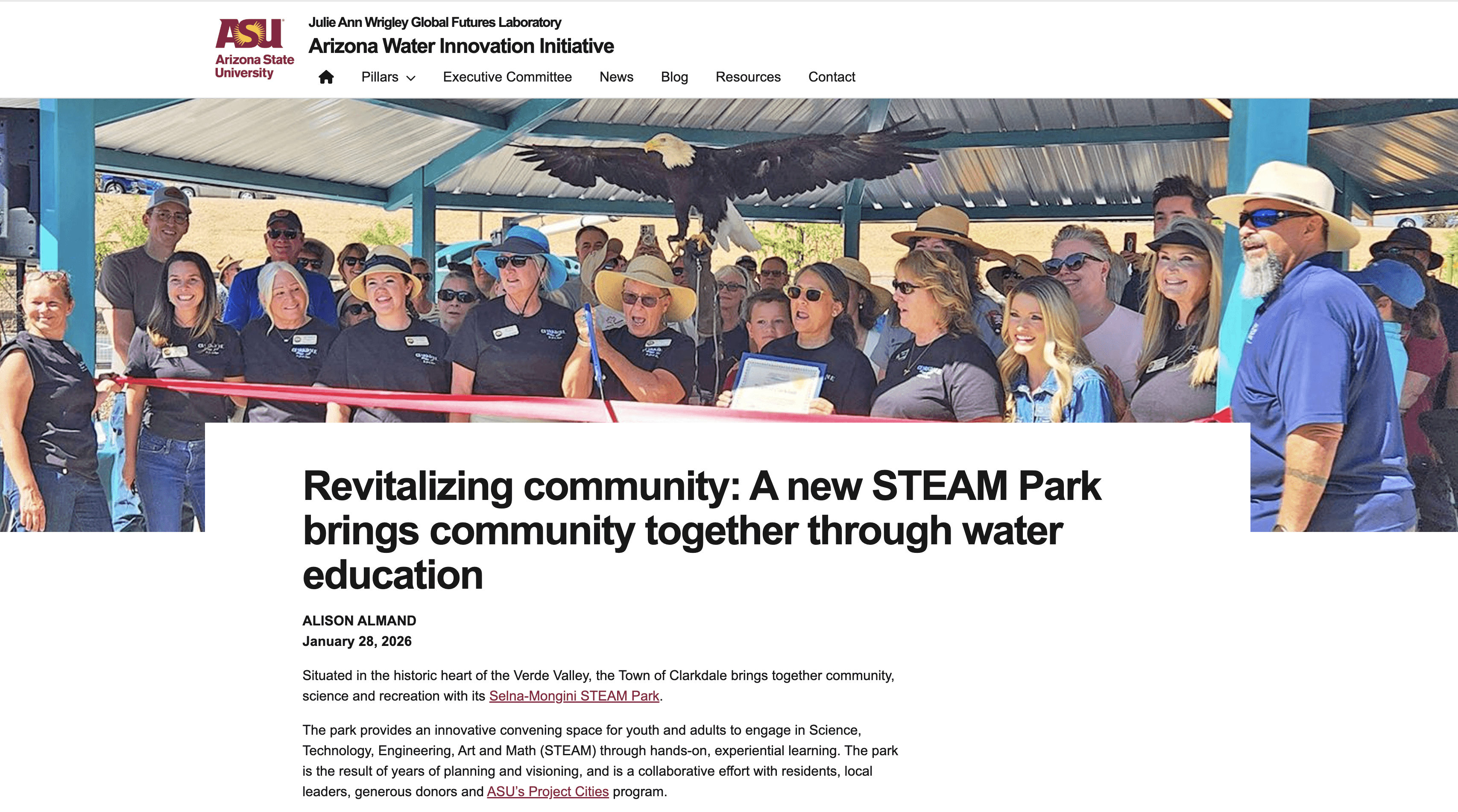
The Town of Clarkdale partnered with ASU's Project Cities program to design educational signage for Selna Mongini Park — something physical, interactive, and honest about the science of water conservation.
We went to Clarkdale.
Not just desk research.
We visited the park site, walked the space, and attended a community meeting with Clarkdale residents. That on-site visit changed the design in ways no literature review ever could have. Project Cities provided existing community data and a complete brand style guide.
The research method that mattered most was the eye tracking study. We ran our draft designs through eye tracking software to map exactly where gaze landed first and how long it stayed. The data showed what was being skipped. We restructured the information hierarchy on every sign so critical content sat where eyes naturally went first.
EYE TRACKING STUDY
Where people looked.
What they skipped.
What we changed.
Draft designs tested through eye tracking software. Gaze patterns mapped. Information hierarchy restructured. Every sign improved as a direct result.

02-RESEARCH
Make water conservation understandable
to a seven year old without losing the adults.
The brief from Project Cities was clear in its ambition and hard in its execution. Design interactive, STEAM-focused signage for families and children that carries genuine scientific content. Use the Clarkdale brand guidelines. Make it durable enough to survive an Arizona summer. Make it something people actually stop to read.
Visual Hierarchy
Legibility & Readability
Engagement
Comprehension & Recall
Attention & Distribution
Maintenance & Durability
03-THE BREIF
The Landscape Basins
Puzzle Piece Sign.
Landscape Basins Puzzle Piece Sign · "Conserving Water Wise Landscape Basin" · "The Gem of Arizona" · Clarkdale Park, Fall 2024
The Puzzle Metaphor
Each piece = one conservation action. Together they form the complete picture. The metaphor does the work before anyone reads a single word.
Cartoons Over Photos
Photos feel like textbooks. Cartoons feel like invitations. Agave replaced saguaro — ecologically accurate to Clarkdale. Eye tracking confirmed kids engaged more.
QR Code to iNaturalist
The sign becomes a starting point not a destination. Families scan and document local wildlife in the park right now. Passive reading became active participation.
04-MY DESIGN

05 — BEFORE & AFTER
From what to do
to why it matters.
BEFORE

Conservation Actions
Five tips about what to do — choose native plants, avoid over-watering, relocate plants, add mulch, reduce growth. Correct. But told visitors what to do without explaining why the basins themselves matter.
→
AFTER

Benefits of Parks Landscape Basins
Each piece now explains what the basin does — collect rainwater, help water soak into ground, slow runoff, clean rainwater before it soaks in, give trees a steady drink. Plus iNaturalist QR code. Title changed to "Benefits" not "Tips."
06 — ALL SIX SIGNAGE DESIGNS
Six signs. Six water stories.
One coherent park experience.

Explore the Water Cycle
Headwaters, riparian zones, conservation tips. Replaced saguaro with century plants for accuracy. Wood Plastic Composite material — waterproof, UV resistant, elevated 1ft for eye-level reading.

Low-Water Trees
Chilean Mesquite, Palo Verde, Desert Willow, Afghan Pine. Drip irrigation diagram. Dynamic visual layout replacing a standard pyramid format.

Recycled Water for Irrigation
Grass-shaped aluminum sign. Interactive flippable circles — question front, answer back. Five-step water recycling process from source to Class C irrigation water.

Rainwater Harvesting System
Six-step process: rainfall, collection, filtration, storage, plantation, usage. QR code with video animation for kids. Native species Chocolate Flower and Desert Marigold featured.

Low-Water Lawn System
Drip irrigation saving up to 50% water, mulching, deep root watering, leak repair. Step-by-step visual flow. Footer: "Save water and enhance sustainability with simple practices!"
"
The puzzle piece is not my metaphor. It came from understanding what Clarkdale actually believes:
that conservation is not one big dramatic action — it is a hundred small ones that fit together.
— Ashritha Vanam
07 — WHAT CHANGED & WHAT I STILL WANT TO BUILD
Three changes made.
Two ideas still on the table.
Saguaro → Agave
First feedback from Clarkdale review: the saguaro is not native here. Swapped to agave plants. One change that made the whole sign more ecologically honest.
Photos → Cartoons
Eye tracking showed photos were being skipped by kids. Switched to cartoon illustrations. The sign stopped feeling like a classroom and started feeling like a park.
Tips → Benefits
The draft told you what to do. The final tells you what the basins actually do. That shift from instructions to understanding changed everything about how the sign works.
IDEAS I STILL WANT TO BUILD
Flip Panel QR System — flippable wooden or metal piece, two QR codes engraved: one to iNaturalist, one to a Clarkdale audio guide for visitors with disabilities. Accessibility baked into the physical object, not bolted on.
Physically Movable Puzzle Pieces — actual pieces on the sign that kids could slide and rearrange. Not a printed metaphor. A real interactive object. That is the right idea for this space.
BY THE NUMBERS
6
Signage designs
completed
1
Site visit to
Clarkdale
6
Team Science
members
Eye Track
Validation
method used
ASU
Newsletter feature
March 2026
WPC
Material: Wood Plastic
Composite
08 — WHAT IT TAUGHT ME
Design decisions have to earn their place
against a real audience in a real environment.
Abstract aesthetics do not survive contact with a six year old in a park. Every choice I made was eventually tested against that reality.
Working with Clarkdale showed me that community design is not about imposing a vision. It is about listening carefully enough that the community's own values show up in the final work.
The eye tracking study was the most technically rigorous and most humbling part of this project. I thought I knew where the important information was. The data disagreed. I moved things.
Small detail, big lesson: good signage design is not about what you think looks right. It is about what the data says people actually see.
Citizen Science
Accessibility Design
Brand Systems
Community Engagement
STEAM Signage
Eye Tracking Research
Technical Writing
Environmental Communication
TEAM SCIENCE · TWC 501 · FALL 2024
PV
Priyal Vasaiwala
Team Member
YJ
Yasti Jain
Team Member
SD
Sonu Desai
Team Member
SS
Subhiksha Shanmugan
Team Member
RC
Rishabh Chauhan
Team Member
AV
Ashritha Vanam
Landscape Basins Designer